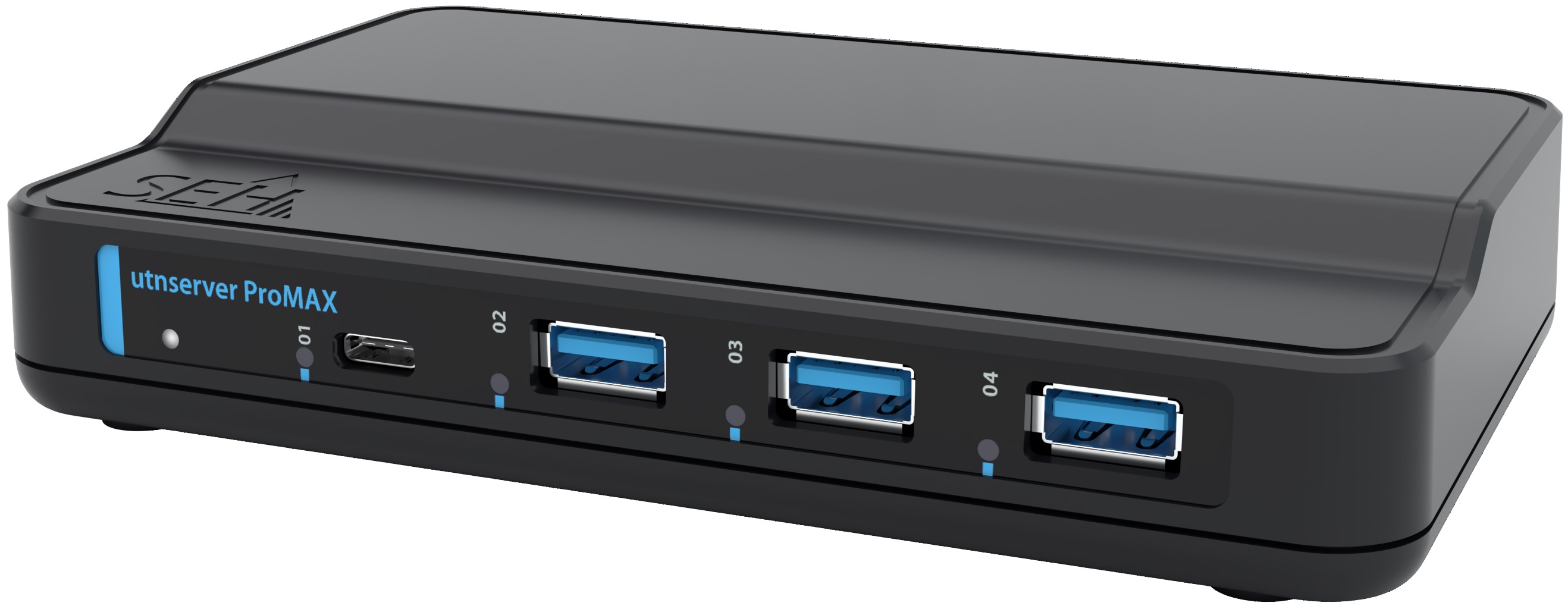
utnserver ProMAX

The 360° Business Solution

Workflow optimization thanks to enterprise architecture - the utnserver ProMAX convinces as a holistic 360° business solution for your company. Regardless of whether you work from your home office or directly from the office in the corporate network: The high-class device server offers plenty of interfaces and numerous features that support you in your daily work and sustainably improve your workflows.

At a Glance

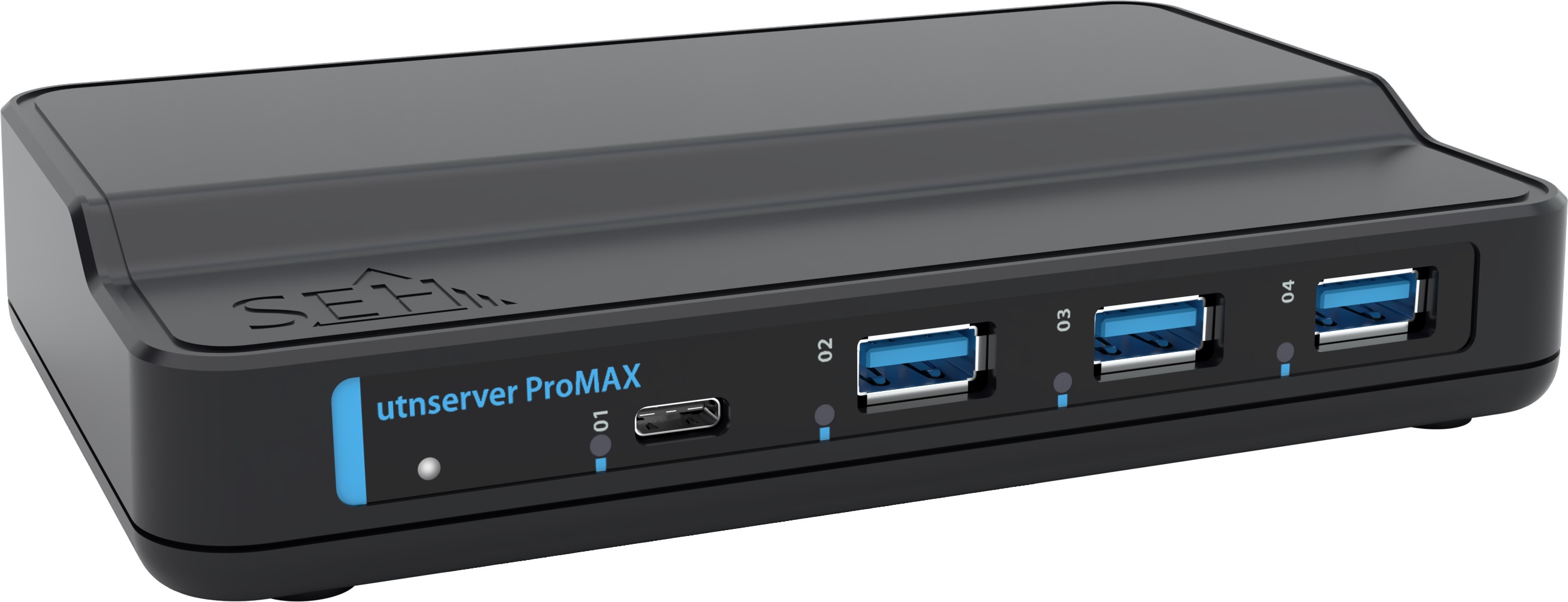
4 x USB 3.2 Gen 1 (SuperSpeed)

SSL/TLS encryption

190 MB/s throughput

NBase-T network connection

Product overview

Here is an overview of our technical specifications and security features to help you understand the key capabilities of our product.

Features

Network

1 × RJ-45, shielded
IEEE 802.3bz (2.5GBASE-T, 1000BASE-T, 100BASE-TX, 10BASE-T)
IPv4, IPv6

Interfaces

1 × USB 3.0 SuperSpeed, Type-C (USB port 1, USB BC 1.2 with up to 1.5 A)
3 × USB 3.0 SuperSpeed, Type-A (USB ports 2–4)

Management Software

SEH UTN Manager (connection management)
SEH Product Manager (network device management)
Control Center (integrated user interface for configuration, administration, monitoring and maintenance via browser)

Supported operating systems

Microsoft Windows 10, 11 (SEH UTN Manager also for ARM64)
Microsoft Windows Server 2019, 2022, 2025
macOS 15 (Sequoia) or later
 

Monitoring & Logging

WebDAV export (event log, backup), syslog export (syslog-ng)

Updates & Support

Regular software updates, technical support worldwide

Security

Encryption

TLS 1.2/1.3, HTTPS

Authentication

IEEE 802.1X (EAP-MD5, EAP-TLS, EAP-FAST, EAP-TTLS, PEAP)

Certificate management

Self-signed certificate, certificate request, CA certificates, client certificates, PKCS#12 certificate, S/MIME certificate

Network security

SNMPv3, VLAN (IEEE 802.1Q)
TCP port access control (Whitelist/Blacklist, IP and MAC address filter)

Access control

Device access control (password protection, session login, user accounts: Administrator, USB Manager, Read-only user)
USB port access control (time-based port key control, device assignment, USB port deactivation, timeout)
USB HID class blocking, USB MSD class blocking

Notifications

Email notifications (status, certificate expiry), SNMP traps

Tools & Documentation

Insights

Functionality utnserver ProMAX

Benefit from digital enterprise freedom instead of local USB dependency! The utnserver ProMAX is suitable for all operating systems and provides all kinds of USB devices over a network. A true all-rounder that works according to the "Plug & Play" principle: Simply include it in the network, connect USB devices and access all devices network-wide.

MAXimum performance

A device of the high-end class. As the first UTN server, the ProMAX has an NBase-T network connection and scores with its performance all along the line.

MAXimum speed

Highspeed has a new name. Benefit from a maximum data throughput of up to 190 MB per second.

MAXimum compatibility

Versatile. The utnserver ProMAX is suitable for all common operating systems. A total of four future-proof USB 3.0 SuperSpeed ports, both Type-C and Type-A, are at your disposal.

MAXimum security

Security first. All USB communication is fully encrypted via a direct point-to-point connection, protecting your USB devices from unauthorized access.

5 Year Warranty

Extend your warranty by up to 60 months

Find out more
Order Number

  • M05400 (EU)
  • M05401 (UK)
  • M05402 (US)
  • M05403 (JP)

FAQs

We know our products can be complex. These FAQs cover the most common questions about using and implementing them in your daily work. For specific questions, please contact our Support Team.


For SNMPv3 communication with USB Device Servers, the following methods are supported:'
Authentication:
MD5SHA-1 / SHA-96
Encryption:
DES / AES-128SHA-2 
methods such as SHA-224 and SHA-256, as well as AES-192, AES-256, and 3DES, are not supported. If your SNMP client uses one of these methods, a connection cannot be established.
 

SEH USB Device Servers can be used in virtualized environments, provided that the operating system, virtualization platform, USB device, and application support the required USB redirection scenario.

Show all FAQs